
Find Stanislaus County Residents
Start with the question, not a broad name box. An address points to a parcel and its titled owner. A court question belongs in the Superior Court party index. Birth, death, and marriage questions go to the Clerk-Recorder or the state public health department. A past household may take a city directory, census schedule, obituary, or archive. These sources overlap, yet none carries the same facts as another.
Property records show a legal tie to land. They do not roll up every person living there. The voter status tool verifies one voter, not a public street list. Historical books reflect the names and addresses a publisher gathered in a particular year. Treat each hit as a lead. Then confirm with a second record. It should show a date, address, co-party, parcel, or family link. Only then call the person the right one.
Match the record to the goal first. Use this starter sequence for lawful family-history, estate, reunion, or civic record searches:
- Write down the full name, spelling variants, approximate date, city or community, and any known address.
- Use GIS or an APN already in hand to locate the parcel, then read the assessor information that the public channel exposes.
- Search the recorded-document index by name, APN, date, or document number and separate grantors, grantees, liens, and releases.
- Use the court, vital, business, or license source that matches the question instead of treating one index as universal.
- Move to the library, State Archives, university collections, counter terminal, phone desk, or CPRA request channel when the web record stops.
Stanislaus County Records Offices
Four county desks anchor the Stanislaus County residents directory. The Clerk-Recorder indexes deeds, liens, maps, fictitious business names, notaries, births, deaths, and marriages. The Assessor keeps the assessment roll, parcel numbers, maps, values, exemptions, and property characteristics. Elections handles registration and lawful voter-file access. The Superior Court holds case indexes and files for civil, criminal, family, probate, small claims, and traffic matters. City and county offices split permits by parcel jurisdiction.
Stanislaus County Clerk-Recorder
1021 I Street, Suite 101
Modesto, CA 95354
209-525-5250
Clerk-Recorder services
Stanislaus County Assessor
1010 10th Street, Suite 2400
Modesto, CA 95354
209-525-6461
Assessor data services
Stanislaus County Elections
1021 I Street, Suite 101
Modesto, CA 95354-2331
209-525-5200
StanVote services
The channel matters as much as the office. The free web inquiry expects an APN. Office kiosks open broader assessment fields. RecorderWorks gives a free index, but image and copy orders follow a different process. Elections shields specified voter fields by purpose. The public index often starts a trail rather than ending one.
Each route wants its own inputs. For street-by-street parcel work, take the Stanislaus County street directory angle. The one-person record path sits in a Stanislaus County resident lookup, where court, vital, business, and license records can be weighed together.
One rule keeps the office map clear. Confirm the parcel's city or county jurisdiction before requesting permits or code records, since a Modesto postal label can cover an unincorporated county island. Postal city names mislead.
Note: Stanislaus County Clerk-Recorder services are the first office stop for recorded instruments and local certificates, but each record type carries its own access rule.
As an orientation aid, the county separates ownership evidence, electoral status, court events, and vital events. No single roll combines them.
Stanislaus County Parcel Search
The assessor-GIS pairing bridges address to record in Stanislaus County. The free Public Inquiry path asks for a parcel number in 000-000-000 format with dashes. Map tools come first without an APN. The county GIS viewer, map books, and parcel layers help locate a property's shape. They also clarify its jurisdiction. Office kiosks widen the view during Assessor hours. A restricted Online Agency Inquiry adds name and situs searching. It carries a $300 annual charge. It also requires a login, a user agreement, and a demonstrated business need.
Do not confuse situs with mailing. Situs is the physical property location. Mailing is where the owner wants tax correspondence sent. A matching address can support an owner-occupancy hunch. But neither field proves who lives at the parcel. A legal description and APN are stronger bridges into deeds. A street number can change, while the land description stays recognizable.
| Field or control | How it works in Stanislaus County |
|---|---|
| Parcel Number | Required by free Public Inquiry; enter the county APN with dashes. |
| Name | Available through public kiosks or restricted Agency Inquiry, not the free web path. |
| Situs | Physical property address in the broader data service; it is not the tax-mailing address. |
| Search | Submits the selected parcel or authorized data-service query. |
The county GIS layer adds parcel geometry, city limits, annexations, and districts. It never names the owner. RecorderWorks connects a known APN to an indexed instrument. This separation makes address-first searching more reliable than guessing a resident from a postal city name.
The Stanislaus County GIS viewer is the map bridge. The county parcel map is a research aid, not a survey or title opinion.
The Assessor Public Inquiry page shows the APN-first route.
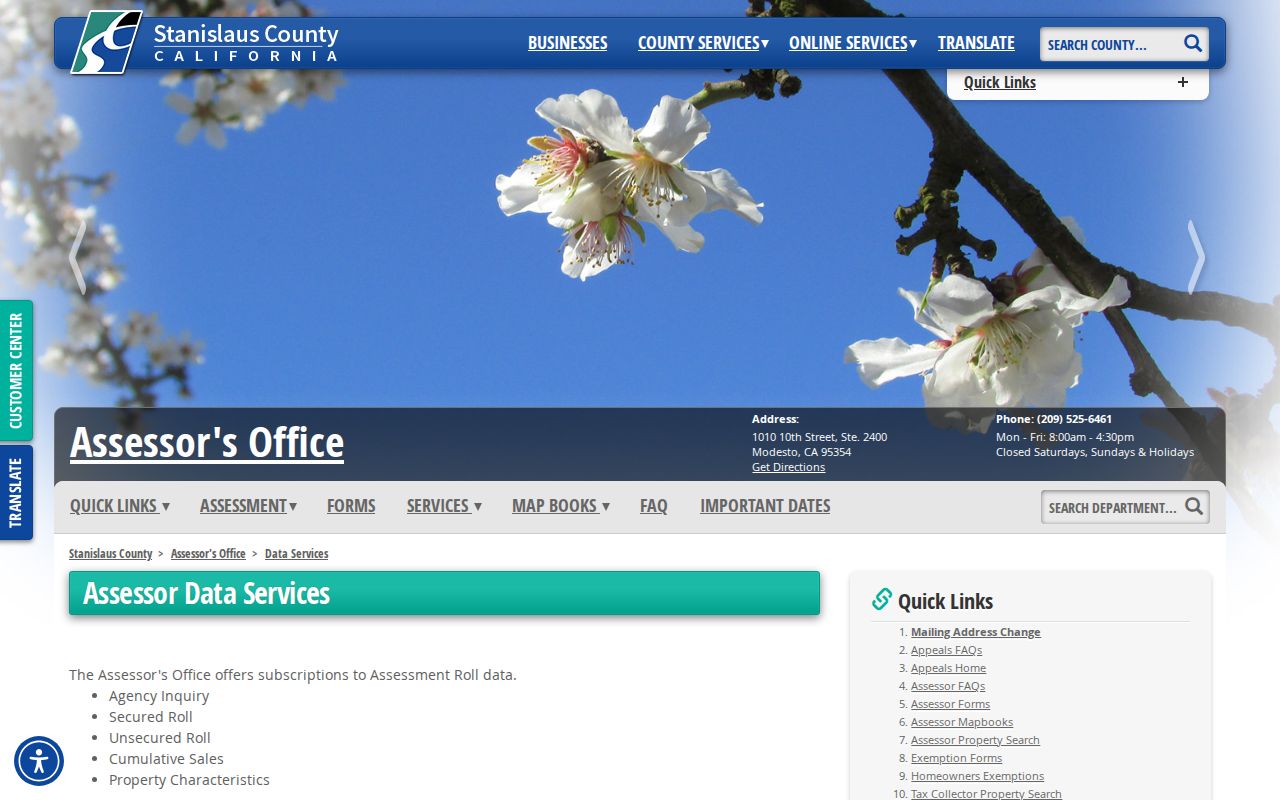
The parcel screen earns its keep once GIS hands you a parcel number. Broader owner and situs searches still live at the office kiosk or a restricted service. Plan the trip accordingly.
The jurisdiction check doubles as a geography lesson. A Stanislaus County residents directory has to stretch across nine incorporated cities, rural routes, and unincorporated communities. It is not just Modesto. The county is bigger than its seat.
Note: Keep the query date and exact APN beside any result. Assessment data may be stale or corrected later.
Stanislaus County RecorderWorks Trail
RecorderWorks is the county's name-rich trail of recorded documents. Its notice claims index coverage from January 1, 1850 to the present. Even so, Stanislaus County was organized in 1854. Treat 1850 as the system's stated boundary rather than a typo. Before assigning a result to the county, inspect the document date, jurisdiction, book or map reference, and parties. The portal offers many search modes. These include Name, Document Number, Document Type, Map, Recording Date, Book and Page, Parcel Number, Legal Description, and Options.
For a residents directory question, the strongest approach is a chain. Search a known owner or APN first. Open the document detail and read it closely. Note the recording date, document type, indexed names, document number, and legal description. Then select a prior grantor or co-owner and search again. A grantor transfers an interest; a grantee receives it. A lien, deed of trust, or reconveyance is weaker evidence. It is not the same as a grant deed.
| RecorderWorks input | Useful format | What it narrows |
|---|---|---|
| Person or business name | LAST NAME, then partial first name; partial matching is available | Indexed party and related instruments |
| Recording date | MM/DD/YYYY range; broad searches can time out | Chronology and likely transfer window |
| APN or legal description | Parcel-linked or land-description mode | Same-name separation and parcel continuity |
| Document type or number | Specific instrument or annual number | Deed, lien, map, release, or other filing |
The county's RecorderWorks Official Records portal provides the public index entry point. That is where a Stanislaus County residents directory trail through recorded documents begins.
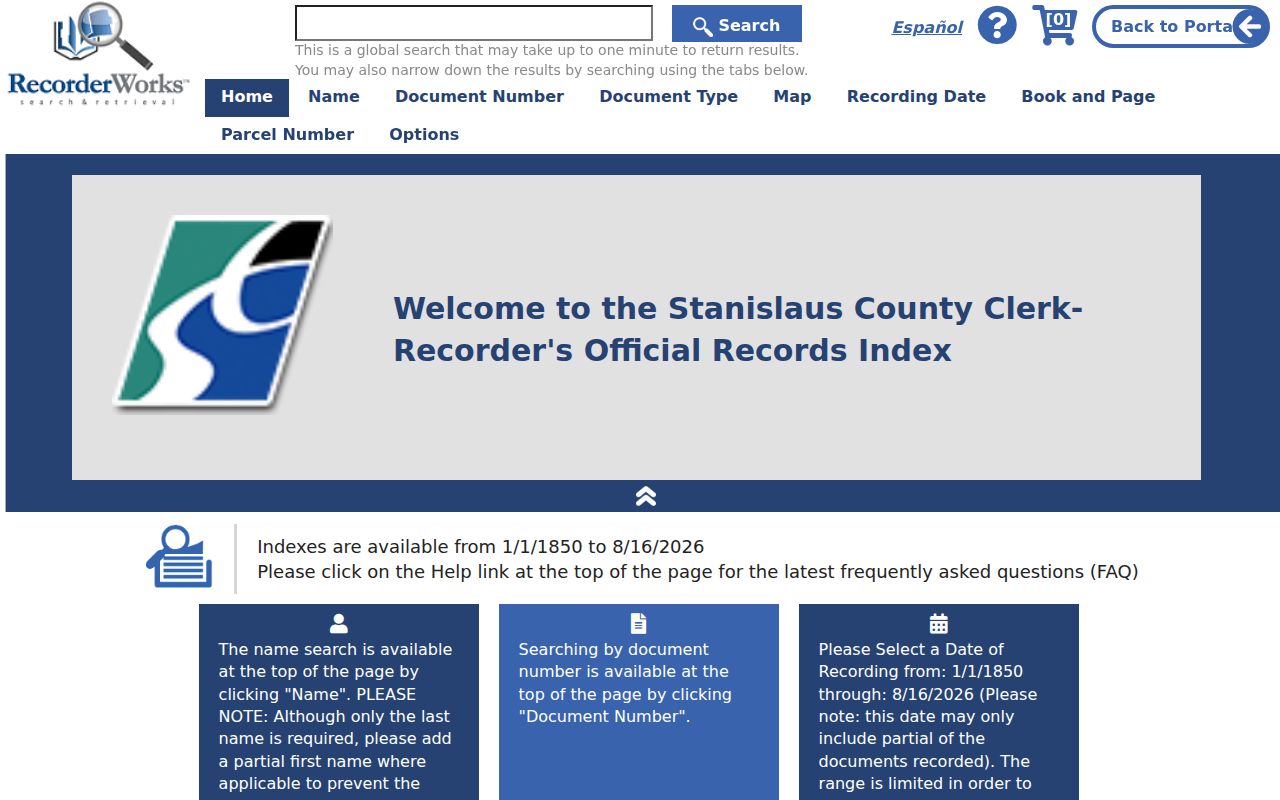
Treat an indexed party as a clue, not a conclusion. Then inspect the instrument and the parcel. The image or a certified copy can answer a document question. A name-only hit never will.
RecorderWorks proves that a named party appears in an instrument. It cannot prove present occupancy without independent evidence. That is the central difference. A record trail is not a true resident roll in Stanislaus County.
Current Stanislaus County Directories
Current sources overlap in a local directory, yet each lists a different population. The Assessor identifies parcels and owners through permitted channels. RecorderWorks identifies parties to instruments. The voter status service authenticates one voter at a time. A city staff directory lists public business contacts. A license or business filing ties a person to an organization. It may also tie them to a professional record. None of these is a complete household list for a Stanislaus County residents directory.
| Source | Population or record | Custodian | Access character |
|---|---|---|---|
| Assessment and parcel data | Owners, situs, values, exemptions, characteristics | County Assessor | APN web inquiry, kiosk, or restricted product |
| Recorded-document index | Grantors, grantees, liens, maps, releases | Clerk-Recorder | Free index; copies follow order rules |
| Voter status | One voter's registration and election details | California Secretary of State | Self-authentication, not a name directory |
| Business and license records | Entities, agents, registrants, license status | California agencies and county Clerk-Recorder | Public search with record-specific limits |
| Municipal staff directory | Official city names, titles, and work contacts | City of Modesto | Public business directory, not private resident data |
Match the question to the source before you search. Probate files and recorded transfers settle an estate question. Yearbooks and school collections help track down a former classmate. A state license record can confirm a current professional affiliation. For parcel questions, turn to GIS, the Assessor, and deeds. Scope is part of the evidence, so weigh it every time.
Official does not mean complete. The Stanislaus County residents directory leaves real gaps. A person never named in a deed stays invisible there. So does a voter whose record is confidential. So does a household member who owns no land. So does a historical resident outside a publication year. Every residents directory reflects the records behind it. The matching table can only reach as far as those records go.
Stanislaus County Voter Records
California's voter status tool plays a narrow role in a Stanislaus County residents directory. It authenticates the voter with first name, last name, date of birth, and a driver license or ID number. A voter may instead supply the last four digits of a Social Security number. The result can show registration status, party, and language preference. It can also show vote-by-mail or provisional-ballot status, polling place, election information, the county contact, and guide-delivery preference. It exists for self-verification. It is not built for browsing names along a street.
A formal voter-file request runs through a separate channel. Elections Code section 2194 limits file use to election, scholarly, journalistic, political, or qualifying governmental purposes. Government Code section 7924.000 shields home street address, telephone, and email. It also shields specified identifiers, signature, and related registration fields. Confidential registrants stay excluded except under narrow approved access. Never infer a household from one registration result. Never read a missing result as proof a person moved away.
The Stanislaus County Elections site illustrates the authenticated status path, not a public resident directory.
Use the tool only for a voter checking their own record. For historical research, ask the State Archives or County Elections office about a dated register. Ask as well about its access rules.
| Voter field | Public status or authorized file |
|---|---|
| Name and date of birth | Used for self-authentication; date of birth is in approved voter-file data, not an open web directory. |
| Registration and precinct | May appear in an authorized file with purpose and security controls. |
| Participation history | Optional election/date/method information; never ballot choices. |
| License, ID, SSN, signature | Excluded from released files under the statutory rules. |
The Stanislaus County Elections site illustrates the authenticated status path, not a public resident directory.
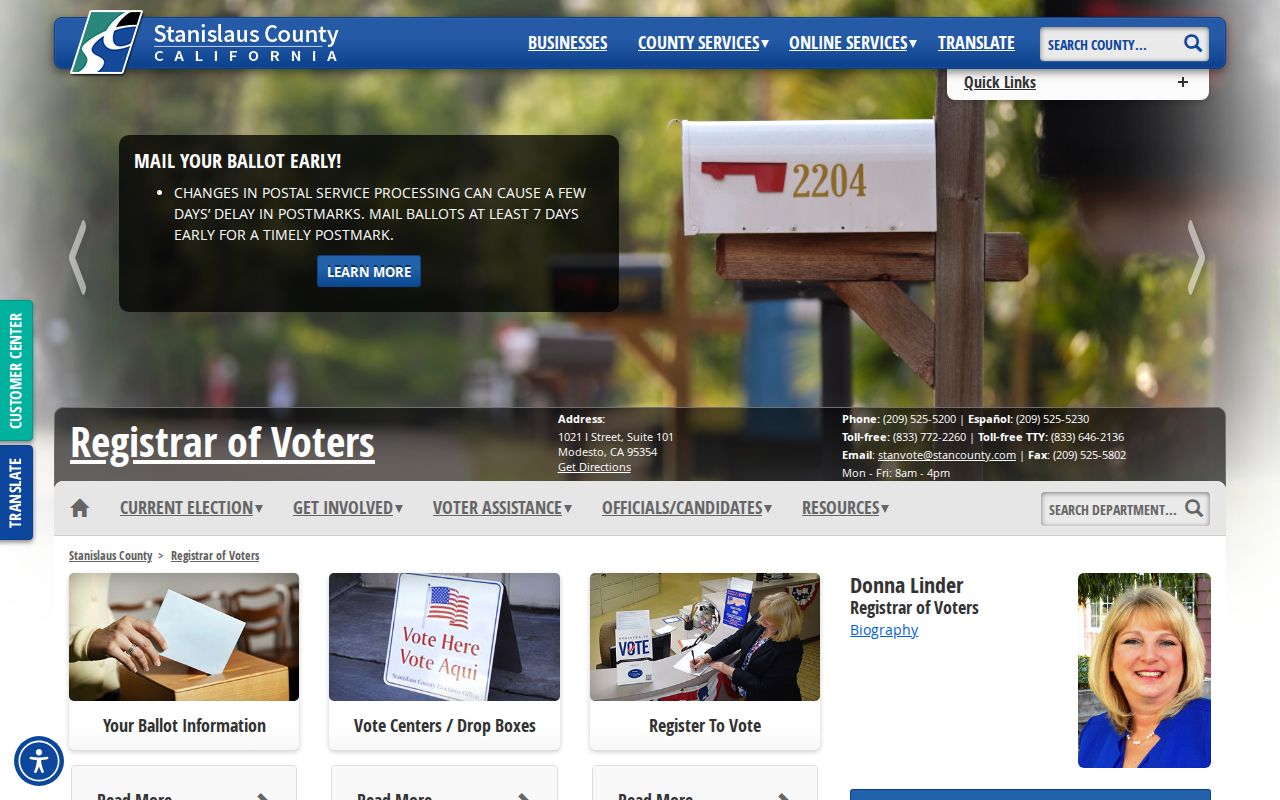
Use the tool only for a voter checking their own record. For historical research, ask the State Archives or County Elections office about a dated register and its access rules.
Stanislaus County Court Leads
Court indexes and vital records solve different problems. The Stanislaus Superior Court public portal takes a case number, a party name, or a business name. A match may return the case type, filing details, current status, and docket entries. A docket is simply the court's chronological event log. Treat it as a finding aid. It is not a verdict. Sealed, juvenile, adoption, and protected family files stay hidden. Records open at the courthouse can be narrower online.
Birth, death, and public marriage certificates follow the state's California vital-records program rules. Those rules split copies into authorized and informational versions. An informational copy confirms a lead but proves no identity. An authorized copy demands a qualifying relationship or role. Mailed requests also need a notarized sworn statement. The January 1, 2026 county fee notice sets $34 for birth, $28 for death, and $19 for marriage certificates. Divorce decrees stay with Superior Court. A CDPH certificate of record is not the decree itself.
| Question | Best record lead | What to verify |
|---|---|---|
| Was a case filed? | Stanislaus Superior Court public index | Party identity, case type, status, disposition, and access limits |
| Did a vital event occur? | County Clerk-Recorder or CDPH | Event date/place, copy type, eligibility, and current fee |
| What is the official file? | Clerk copy request or research form | Case number, filing year, delivery choice, page and certification charges |
The Stanislaus Superior Court case search image shows the public entry screen. A court match still needs disposition and context.
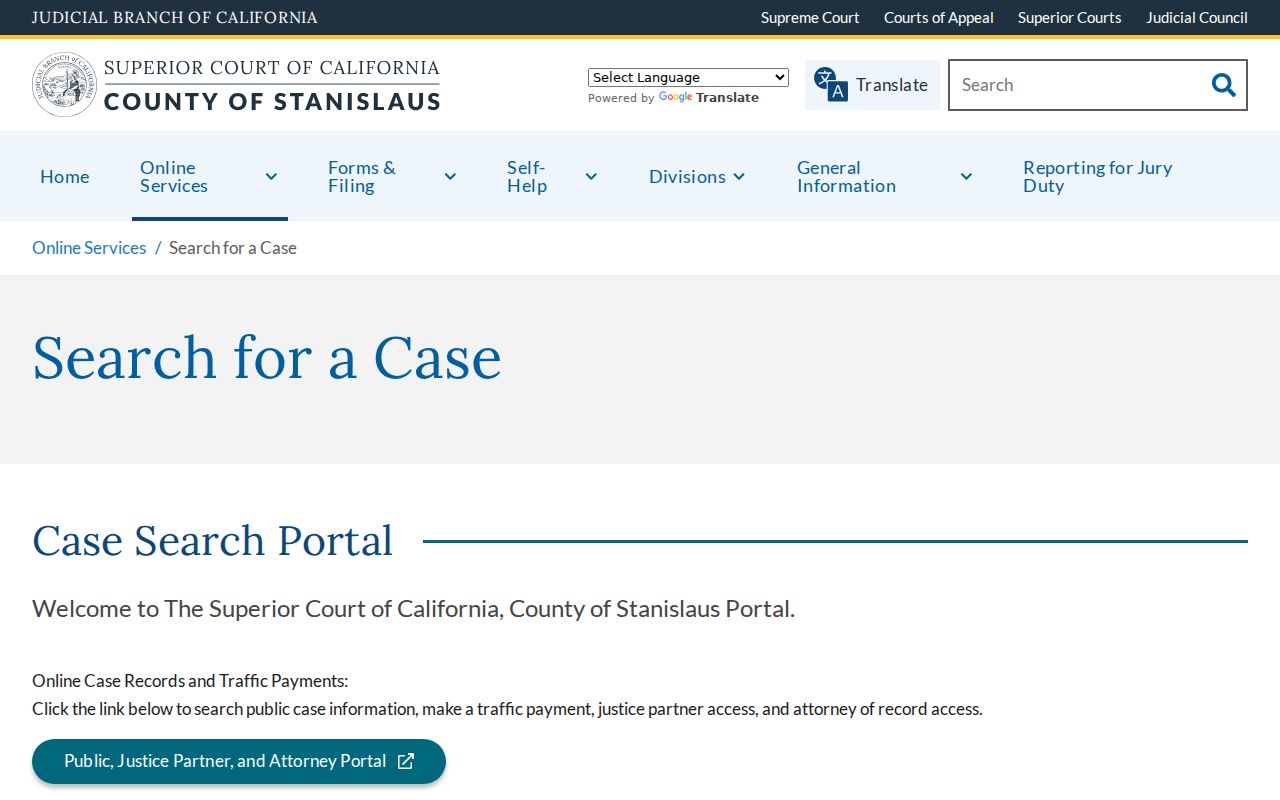
Order a certificate from the current custodian with the current form. An index name is not a certified copy accepted for identity.
Stanislaus County Identity Cross-Checks
Business and professional filings can tell apart people. This helps when several residents share a name in a Stanislaus County residents directory. California's bizfile search ties an entity to its file number, status, formation date, agent, principal address, and filed statements. County fictitious business name records add a local registrant trail. The Clerk-Recorder cautions that duplicate or similar names get filed. The office runs no uniqueness check for filers. A state license search can add license type, status, issue or expiration dates, and public discipline where a board publishes it.
These sources shine when a person is known by a role, trade, or organization. They do not prove a home address. An agent for service of process lists a service address. A facility inspection names an establishment. A trade name names a filing. Anchor the result against a parcel, deed, court record, date, or archive source. For historic names, search the spelling printed in the source first, then variants, since community collections often record several transliterations of one name.
| Cross-check | Useful fields | Limit |
|---|---|---|
| State entity filing | Entity name, status, dates, agent, officers or managers in filed statements | Entity or agent address is not proof of residence |
| County fictitious business name | Registrant, trade name, filing and renewal dates | Similar names can coexist |
| DCA or board license | Name, license number, type, status, city or county filters | Only participating boards and published fields apply |
The California bizfile business search and DCA license search work best as independent role or date anchors for a Stanislaus County identity cross-check. A current filing can test whether two records describe one person, yet no filing turns a work contact into a private resident list.
The county's FBN warning carries a consumer lesson too. An official-looking renewal letter can lift public filing facts and demand $169. Verify with the Clerk-Recorder before paying or sharing anything.
Stanislaus County Privacy Rules
A responsible Stanislaus County residents directory uses the least detail a lawful question requires. California's Safe at Home program gives eligible participants a substitute mailing address. It also offers a confidential voter-registration route. A protected address may be missing or mismatched on purpose. Recorded deeds stay public. Voter home addresses, DMV personal information, signatures, and similar protected identifiers never count as open directory fields.
California's Delete Request and Opt-out Platform is called DROP. It launched in 2026 so consumers can push requests to data brokers. A verified California resident submits identifying information. They receive a request ID, track outcomes, and have participating brokers revisit their lists on the program's schedule. An opt-out only changes a compiler's copy. It cannot erase a deed, court filing, assessment record, or vital record held by its lawful custodian.
Lawful personal research. Public records may support family history, estate work, reconnection, or civic review. Do not publish a protected address, threaten a person, or use a record to stalk, harass, intimidate, or harm anyone.
California offers two state-level privacy routes for Stanislaus County residents. Safe at Home handles address confidentiality, while California DROP covers data-broker requests. Fix factual errors with the original custodian of the record. Suppress any commercial copy on its own, separately.
The California Public Records Act, Government Code sections 7920.000 through 7931.000, works as a fallback for an identifiable existing county or city record. It cannot force an office to build a resident list, answer a research question, or release a record another law protects. For a focused request, start with the California public-records statute itself.
Offline Stanislaus County Sources
Web indexes are just one channel into Stanislaus County records. The Modesto Library's Special Collections holds genealogy materials and local history. It also keeps older high-school yearbooks and non-current telephone directories. Its city directories are described as dating to 1914. Nothing circulates. During the 2026 main-library renovation, retrieval conditions can shift. Call the Reference Desk before traveling. The State Archives and Family History Centers hold microfilmed county series. These cover early deeds, probate, naturalization, marriages, births, homesteads, and declarations of intention.
University archives supply a different flavor of resident evidence. The Stanislaus County Oral History collection holds eight boxes of interviews and transcripts. The interviews span 1957 through 2006. Oral testimony can explain a move, a family tie, or a vanished street name. It can also capture a community role a deed only hints at. The catalog also holds maps and county documents saved from disposition. Treat an archive description as a finding aid and ask the repository about access conditions.
The Stanislaus County Library local-history page is the best first contact for its physical collections.
The library remains the quiet doorway into older Stanislaus County paper trails. A reference request there can surface a directory year or a newspaper run that a general web search never touches. For county series that sit beyond local shelves, the California State Archives catalog offers the archival route.
Archives and library shelves fill different gaps in Stanislaus County records. One preserves government series and microfilm, while the other holds local books, directories, newspapers, and staff who know the collections.
Stanislaus County Records History
Old names read differently once you know the record geography. Stanislaus County moved its county seat five times between 1854 and 1871. The stops were Adamsville, Empire City, La Grange, Knights Ferry, and Modesto. So an early court or administrative reference to one of the first four places is a clue. It points to jurisdiction. It is not a bad address. A family could stay put in the same broad county. The labels around it kept shifting. Court, post office, newspaper, and street directory headings all changed with the seat.
Preservation has its own custody story. In 1939 the county built a Hall of Records for $200,000. The court history reports completion in 60 days. Modern work continues that tradition. A $1 additional recording fee supports permanent-record preservation, archival microfilm, digital imaging, and storage. AB 137 removed the January 1, 2026 sunset, keeping the fee alive. That steady funding line helps explain something. Old deed images and indexes still connect to present-day residents directory searches.
- 1854: the county forms and Adamsville wins the first county-seat vote.
- 1854-1871: the seat moves through Empire City, La Grange, and Knights Ferry before Modesto.
- 1939: the Hall of Records gives permanent custody a dedicated building.
- 2025-2026: preservation funding and digitization projects extend access to old records and oral histories.
This history is practical, not decorative. It tells a researcher where to look when a modern Stanislaus County office has no matching early label, and why an archive or university repository may hold a record that once sat in a county office.
Historical Stanislaus County Directories
The historical Stanislaus County residents directory is a shelf, not a single database. Modesto Library Special Collections holds city and telephone directories, older yearbooks, local-history books, newspapers, and genealogy aids. Descriptions place some government and directory material as far back as 1914. The public catalog does not establish an uninterrupted run, a publisher list, or a complete reverse-directory series. So ask for the exact volume and confirm whether a street section exists.
A typical entry pairs a surname and given name with a spouse or widow notation, an occupation, a street address, and a code. Codes include h for householder, r for rooms or residence, bds for boards, or wid for widow. The key printed in the actual volume controls. An address or criss-cross section flips the order and can reveal nearby listed households. That makes it a genuine street directory tool for tracing neighbors. Absence from one year is a gap, not proof of absence.
Pair a directory year with the nearest deed, census, newspaper, obituary, or school source. The Stanislaus County city directory book has its own deeper treatment. It covers how to read an entry and trace a household through time. Cross-checking against property rolls and voter rolls turns a one-line listing into a verifiable household story.
Printed books also preserve the county's community range. Turlock Assyrian oral histories, school collections, and county-town materials add names and context. A city directory compresses that material into one line. A careful Stanislaus County residents directory search keeps the spelling exactly as the source gives it. Then it tests variants against date and address anchors.
That combination is the whole point of the directory. It supplies a time-stamped address and household clue. Deeds, courts, certificates, and archives supply the records needed to test what the line means.